

Unlocking Your Potential: A Deep Dive into the Transformative Types of Journals for Intentional Living
By thecontextuallife Editorial Team — Senior editors with 10+ years of subject-matter experience.
Published 2026-05-26 · Last Updated 2026-05-26
Affiliate disclosure: This article may contain affiliate links. Recommendations are independent and editorially driven.
In the beautiful journey of intentional living, personal growth, and cultivating a slower, more meaningful lifestyle, few tools are as powerful and versatile as journaling. It’s more than just putting pen to paper or fingers to keyboard; it’s an intimate conversation with your innermost self, a dedicated space for reflection, planning, healing, and dreaming. For women navigating the complexities of modern life, a journal can be a steadfast companion, offering clarity amidst chaos and a quiet sanctuary for self-discovery.
The world of journaling is vast and wonderfully diverse, much like our individual paths to personal fulfillment. There isn’t a single “right” way to journal, nor is there only one type of journal that fits every need. Instead, a rich tapestry of approaches and formats exists, each designed to serve different purposes, nurture various aspects of your being, and support unique goals. Understanding the various types of journals available can empower you to choose the perfect companion for your current season of life, helping you to deepen your self-awareness, enhance your productivity, and foster profound personal growth.
From the free-flowing stream of consciousness in a daily diary to the structured framework of a bullet journal, and from the vibrant expression of an art journal to the focused intention of a gratitude log, each type offers a unique pathway to introspection and self-improvement. This comprehensive guide will explore the myriad types of journals, delving into their distinct benefits, ideal applications, and how they can seamlessly integrate into your intentional living practice. By the end, you’ll be equipped with the knowledge to select the journal that resonates most deeply with your soul’s current desires and helps you manifest the life you envision.
The Profound Power of Journaling: More Than Just Writing
Before we explore the specific types of journals, it’s essential to grasp the overarching benefits that make journaling such an indispensable practice for intentional women. Journaling is not merely a hobby; it’s a profound self-care ritual, a cognitive tool, and a creative outlet all rolled into one. It creates a sacred space where you can process thoughts, feelings, and experiences without judgment, fostering a deeper connection to your authentic self.
Unveiling Clarity and Self-Awareness
One of the most significant advantages of journaling is its ability to bring clarity to a cluttered mind. When thoughts race and emotions swirl, the act of writing them down can untangle the knots, helping you identify patterns, understand triggers, and gain perspective. This process cultivates a heightened sense of self-awareness, allowing you to recognize your strengths, acknowledge your weaknesses, and understand your desires more intimately. It’s like holding a mirror to your soul, revealing insights you might otherwise overlook.
Emotional Regulation and Stress Reduction
Life, especially as an intentional woman striving for balance, can be incredibly demanding. Journaling provides a healthy outlet for emotional expression, serving as a non-judgmental confidante for your joys, sorrows, fears, and frustrations. Externalizing these emotions through writing can significantly reduce stress and anxiety, prevent emotional overwhelm, and promote a sense of calm. It’s a therapeutic practice that helps you process difficult experiences, grieve losses, and celebrate victories, leading to improved emotional regulation.
Fostering Creativity and Problem-Solving
Beyond its therapeutic benefits, journaling is a powerful catalyst for creativity and problem-solving. When you write freely, you tap into different parts of your brain, encouraging innovative thinking and allowing new ideas to surface. It provides a playground for brainstorming solutions, exploring possibilities, and developing your unique voice. Many artists, writers, and entrepreneurs credit their journals for breakthroughs and inspiration, as it offers an unfiltered space for imaginative exploration.
Documenting Growth and Cultivating Gratitude
A journal becomes a personal archive of your life’s journey. It allows you to document your experiences, track your progress, and celebrate how far you’ve come. Rereading past entries can be a powerful reminder of your resilience, your evolving perspectives, and the lessons you’ve learned. Furthermore, specific journaling practices, like gratitude journaling, intentionally shift your focus towards the positive aspects of your life, cultivating a profound sense of appreciation and contentment that ripples through all areas of your existence. This practice of documenting your growth is crucial for maintaining momentum on your personal development path.
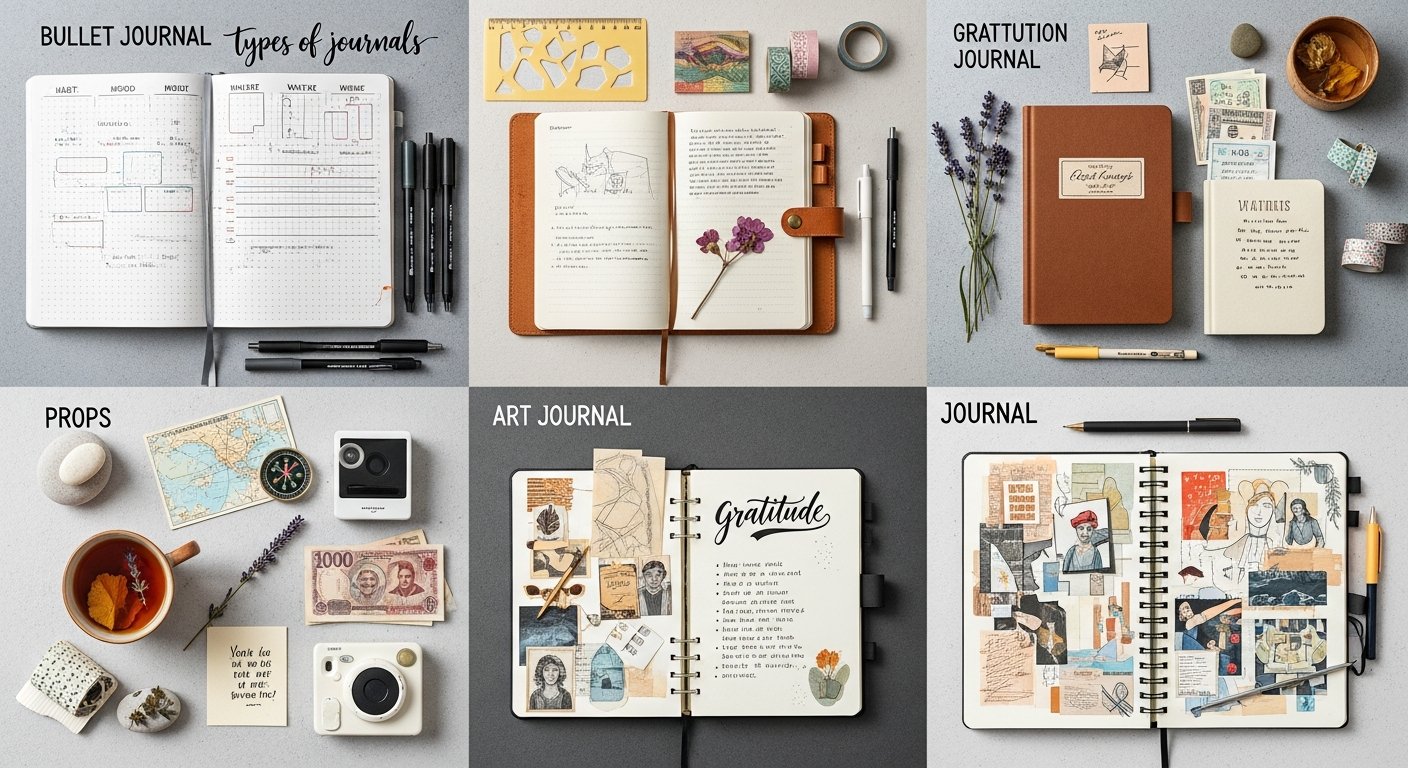
[INLINE IMAGE 1: place after second H2 | alt=”types of journals concept illustration”]
Foundational Journal Types for Self-Exploration and Reflection
These journal types form the bedrock of many personal growth journeys. They are primarily focused on introspection, emotional processing, and understanding oneself more deeply. They encourage an uninhibited flow of thoughts and feelings, making them perfect starting points for anyone new to journaling or those seeking profound self-discovery.
The Free-Form or Daily Journal: Your Personal Confidante
The free-form journal, often simply called a daily journal or diary, is perhaps the most classic and widely recognized type. Its beauty lies in its complete lack of structure and rules. Here, you write whatever comes to mind – thoughts, feelings, observations, daily events, dreams, worries, hopes, and aspirations. There’s no right or wrong way to do it; the only requirement is to be honest with yourself.
- Ideal for: Emotional processing, stream-of-consciousness writing, stress relief, uncovering hidden thoughts, daily reflection, tracking life events without rigid categories.
- How it aids intentional living: It allows you to vent, clarify your feelings, and identify patterns in your emotional landscape. By regularly emptying your mind onto the page, you create mental space for intentional thought and action, preventing the accumulation of unprocessed emotions that can derail your goals. It’s a foundational practice for mindful awareness.
- Tips for practice: Don’t censor yourself. Write quickly and continuously, allowing thoughts to flow without judgment. You can write for a set amount of time (e.g., 10-15 minutes) or a set number of pages (e.g., “morning pages” by Julia Cameron).
The Gratitude Journal: Cultivating Abundance and Joy
A gratitude journal is a dedicated space for regularly noting the things you are thankful for. This simple yet incredibly powerful practice shifts your perspective from what’s lacking to what’s abundant, fostering a more positive outlook on life. It’s a cornerstone of positive psychology and a vital tool for anyone pursuing a slow, intentional lifestyle.
- Ideal for: Boosting mood, reducing negative self-talk, cultivating optimism, appreciating the small joys, fostering a sense of contentment and well-being.
- How it aids intentional living: By consciously seeking out things to be grateful for, you train your brain to notice the good, even amidst challenges. This proactive approach to positivity enhances your overall life satisfaction and resilience, making it easier to navigate life’s inevitable ups and downs with grace and optimism. It encourages you to find beauty in the everyday.
- Tips for practice: Aim for consistency, even if it’s just 3-5 things each day or a few times a week. Be specific; instead of “I’m grateful for my family,” try “I’m grateful for my sister’s thoughtful text message today that brightened my morning.”
The Shadow Work Journal: Embracing Your Whole Self
Inspired by Carl Jung’s concept of the “shadow,” this journal type is dedicated to exploring the unacknowledged, repressed, or disowned aspects of your personality – both positive and negative. It’s a brave and transformative practice that helps you integrate these parts of yourself, leading to greater wholeness and authenticity. Shadow work is crucial for deep personal growth.
- Ideal for: Self-acceptance, healing past wounds, understanding subconscious patterns, integrating disowned traits, breaking self-limiting beliefs, fostering true authenticity.
- How it aids intentional living: By shining a light on your shadow, you gain control over unconscious behaviors and reactions. This allows you to respond to life with greater awareness and intention, rather than being driven by hidden fears or insecurities. It’s about taking ownership of your entire self, leading to more conscious choices and meaningful relationships.
- Tips for practice: Approach with self-compassion. Use prompts to guide your exploration (e.g., “What qualities do I dislike in others that I might possess?”, “When do I feel most inadequate?”, “What secret desires do I suppress?”). This is often best done with breaks and self-care surrounding the practice.
The Dream Journal: Unlocking Subconscious Messages
Our dreams are a rich tapestry of symbols, messages, and insights from our subconscious mind. A dream journal is used to record dreams immediately upon waking, capturing details before they fade. Over time, recurring themes or symbols can provide valuable insights into your inner world, fears, desires, and unresolved issues.
- Ideal for: Gaining insights into the subconscious, creative inspiration, understanding emotional states, processing daily experiences symbolically, improving dream recall.
- How it aids intentional living: By paying attention to your dreams, you can tap into a deeper source of wisdom and creativity. Dreams often offer solutions to waking problems, reveal hidden anxieties, or provide guidance for your personal growth journey. Understanding these nocturnal narratives can inform your waking decisions and help you live more aligned with your authentic self.
- Tips for practice: Keep your journal and a pen by your bedside. As soon as you wake, write down everything you remember, even if it’s fragmented. Don’t try to interpret it immediately; just record. Look for recurring symbols or emotions over time.
Structured Journaling for Productivity and Goal Achievement
While self-reflection is vital, journaling can also be a powerful tool for practical application, helping you organize your life, set and achieve goals, and manage your time effectively. These types of journals bring structure and strategy to your intentional living practice.
The Bullet Journal (BuJo): Your All-in-One Customizable System
Invented by Ryder Carroll, the Bullet Journal is a highly flexible, analog system designed to track the past, organize the present, and plan for the future. It uses a combination of rapid logging, tasks, events, and notes, often alongside custom collections like habit trackers, future logs, and monthly spreads. Its adaptability is its greatest strength, making it suitable for virtually any need.
- Ideal for: Task management, goal setting, habit tracking, creative planning, combining multiple journal types into one system, organization enthusiasts.
- How it aids intentional living: The BuJo empowers you to design a system that perfectly supports your unique needs and intentions. It helps you stay organized, prioritize tasks, track progress towards goals, and reflect on your daily activities. This holistic approach ensures that your actions are aligned with your values, fostering a proactive and purposeful lifestyle.
- Tips for practice: Start with the basic system (index, future log, monthly log, daily log, collections) before adding elaborate designs. Use simple symbols for tasks, events, and notes. Regularly migrate incomplete tasks to ensure important items aren’t forgotten. Learn more about starting your Bullet Journal here.
The Planner/Agenda Journal: Daily & Weekly Organization
Unlike a free-form diary, a planner or agenda journal is explicitly designed for scheduling, task listing, and time management. It often features pre-printed daily, weekly, and monthly layouts, sometimes with sections for goal setting, habit tracking, and notes. Many women find these essential for managing busy schedules and commitments.
- Ideal for: Scheduling appointments, managing deadlines, daily task lists, time blocking, future planning, project management.
- How it aids intentional living: A well-utilized planner allows you to take control of your time, ensuring that your days are spent on activities that align with your values and goals. It reduces mental load by externalizing commitments and helps you prioritize, preventing overwhelm and fostering a sense of accomplishment. It’s crucial for slow living, as it helps you intentionally carve out space for rest and meaningful pursuits.
- Tips for practice: Choose a layout that suits your planning style (hourly, vertical, horizontal). Review your planner daily and weekly. Don’t overschedule; leave room for flexibility and spontaneous moments. Integrate your personal goals alongside professional tasks.
The Goal-Setting Journal: Manifesting Your Aspirations
A goal-setting journal is a specialized notebook dedicated to defining, planning, and tracking your personal and professional goals. It encourages you to break down big aspirations into actionable steps, monitor your progress, and reflect on challenges and successes. This type of journal is a powerful accountability partner.
- Ideal for: Long-term planning, setting SMART goals, tracking progress, maintaining motivation, self-accountability, visualizing success.
- How it aids intentional living: By regularly writing about your goals, you reinforce their importance and keep them top of mind. The act of breaking them down into smaller steps makes them less daunting and more achievable. This proactive approach ensures your actions are always moving you closer to your desired future, transforming dreams into tangible realities.
- Tips for practice: Start with big-picture visioning, then break down goals into yearly, quarterly, monthly, and weekly objectives. Regularly review your progress, celebrate small wins, and adjust your plans as needed. Incorporate visualization and affirmations.
[INLINE IMAGE 2: place after fourth H2 | alt=”types of journals comparison illustration”]
Creative & Expressive Journaling: Nurturing Your Inner Artist
For those who thrive on visual expression, abstract thinking, and unconventional methods, creative journals offer a boundless space to play, explore, and release. These journals move beyond mere words, embracing color, texture, and mixed media to communicate what words sometimes cannot.
The Art Journal: A Visual Diary for the Soul
An art journal is a hybrid of a sketchbook, diary, and scrapbook, where you combine writing with visual elements like drawing, painting, collage, mixed media, and photography. It’s a space for creative exploration, emotional expression, and visual storytelling without the pressure of creating a finished piece of “art.”
- Ideal for: Visual thinkers, artists, stress relief through creative expression, exploring emotions non-verbally, developing artistic skills, documenting life in a visual way.
- How it aids intentional living: Art journaling encourages you to tap into your intuition and creativity, offering a powerful outlet for processing complex emotions and experiences that words alone might fail to capture. It promotes mindfulness and presence as you engage with materials, fostering a sense of flow and joy. This creative practice can be deeply therapeutic and revealing, helping you understand your inner landscape more vividly.
- Tips for practice: Don’t strive for perfection. Focus on the process, not the product. Experiment with different materials (crayons, markers, paint, magazine cutouts). Use prompts if you get stuck, but primarily let your intuition guide you.
The Poetry Journal: Rhymes, Rhythms, and Reflections
A poetry journal is a dedicated space for writing poems, verses, prose, or even just poetic fragments. It encourages a deeper engagement with language, metaphor, and rhythm, allowing you to distil complex emotions and experiences into concise, evocative forms. It’s an excellent way to refine your voice and express profound sentiments.
- Ideal for: Aspiring poets, lovers of language, those who process emotions through metaphor, deep reflection, developing literary skills.
- How it aids intentional living: Writing poetry demands mindfulness and a keen observation of the world around you and within you. It cultivates an appreciation for beauty, nuance, and the power of words, enriching your inner life. This practice can help you articulate complex feelings, find beauty in challenges, and connect with your authentic voice, leading to a more resonant and expressed existence.
- Tips for practice: Read poetry from various authors for inspiration. Don’t worry about perfect rhymes or meter; focus on conveying emotion and imagery. Carry a small notebook to jot down ideas, phrases, or observations that strike you.
The Vision Board Journal (Hybrid): Visualizing Your Future
While often a standalone board, a vision board can also be integrated into a journal. This type of journal combines written intentions, affirmations, and reflections with visual elements like cut-out images, drawings, and photographs that represent your dreams, goals, and desired lifestyle. It’s a powerful tool for manifestation and keeping your aspirations front and center.
- Ideal for: Visualizing goals, manifesting desires, staying motivated, clarifying intentions, creative expression of aspirations.
- How it aids intentional living: A vision board journal keeps your highest aspirations visible and tangible, reinforcing your commitment to intentional living. By regularly interacting with your visual goals and writing about them, you prime your subconscious mind to recognize opportunities and take inspired action. It’s a daily reminder of the life you are actively creating, fostering focus and positive expectation.
- Tips for practice: Be specific with your images and words. Include affirmations and written intentions alongside visuals. Regularly review and update your vision board journal as your goals evolve. Place it somewhere you’ll see it daily.
Specialized Journals for Specific Intentions and Practices
Beyond the general categories, there are numerous specialized journals tailored to particular interests, practices, or areas of life. These can be incredibly effective for focusing your attention and efforts on a specific aspect of your personal growth journey.
The Travel Journal: Documenting Adventures and Discoveries
A travel journal is a beautiful way to capture the essence of your adventures, near or far. It’s not just a record of places visited but also a space for reflections on new experiences, cultural observations, memorable encounters, sensory details, and personal growth witnessed on the road. It can include sketches, tickets, pressed flowers, and other mementos.
- Ideal for: World travelers, adventurers, capturing memories, cultural reflection, personal growth through new experiences.
- How it aids intentional living: Documenting your travels encourages mindfulness and presence during your journey, prompting you to pay closer attention to details and emotions. It allows you to process new experiences, appreciate diverse cultures, and reflect on how travel transforms you. This practice creates a tangible legacy of your adventures, enriching your life and providing a source of inspiration long after your return.
- Tips for practice: Write daily, even if it’s just a few bullet points. Collect small souvenirs (tickets, postcards, leaves) to glue in. Include sketches, maps, and even restaurant menus. Reflect not just on what you saw, but how it made you feel.
The Reading Journal: Deepening Your Connection with Books
For bibliophiles and lifelong learners, a reading journal is a treasure. It’s a dedicated space to record the books you read, your thoughts, insights, favorite quotes, and how a particular book impacted you. This practice transforms passive reading into an active engagement with the material.
- Ideal for: Avid readers, students, lifelong learners, book club members, tracking literary journeys, deepening comprehension.
- How it aids intentional living: A reading journal elevates your reading experience by encouraging critical thought and deeper reflection on the ideas and narratives you encounter. It helps you articulate your insights, remember key takeaways, and apply lessons learned to your life. This practice cultivates intellectual growth, broadens your perspective, and contributes to a rich inner world aligned with intentional learning.
- Tips for practice: Note the title, author, date started/finished, genre, and key themes. Write down powerful quotes. Reflect on your emotional response, new ideas gained, or how the book relates to your own life.
The Health & Wellness Journal: Nurturing Body, Mind, and Spirit
This journal category encompasses various focuses related to physical, mental, and emotional well-being. It can be a food journal, an exercise log, a mood tracker, a sleep diary, or a comprehensive wellness planner. The goal is to monitor habits, identify patterns, and support overall health.
- Ideal for: Anyone focused on health goals, managing chronic conditions, improving mental health, tracking habits, optimizing self-care routines.
- How it aids intentional living: A health and wellness journal provides valuable data about your physical and emotional states, allowing you to make informed decisions about your well-being. By tracking habits, you can identify what works and what doesn’t, leading to more conscious choices about nutrition, movement, sleep, and emotional regulation. It empowers you to take an active role in your self-care and cultivate a thriving body and mind, which are foundational to intentional living.
- Tips for practice: Be consistent with tracking. Don’t just record data; reflect on how different factors influence your mood, energy levels, and overall health. Look for correlations and make adjustments based on your findings. Explore holistic wellness strategies for women here.
The Manifestation Journal: Crafting Your Desired Reality
A manifestation journal is a powerful tool for intentionally bringing your desires into reality. It combines visualization, affirmation, goal setting, and gratitude to align your thoughts, feelings, and actions with your aspirations. It’s often used in conjunction with the Law of Attraction principles.
- Ideal for: Goal achievement, conscious creation, spiritual practice, visualizing success, cultivating a positive mindset.
- How it aids intentional living: By regularly writing about your desires as if they’re already true, you program your subconscious mind for success and keep your focus on positive outcomes. This journal helps you clarify what you truly want, remove limiting beliefs, and take inspired action. It’s a proactive way to co-create your reality and live a life aligned with your highest intentions.
- Tips for practice: Write your desires in the present tense (e.g., “I am so grateful for…”). Include sensory details. Practice gratitude for what you already have and what is coming. Visualize your desired outcome vividly.
The Relationship Journal: Nurturing Connections
This specialized journal focuses on understanding and improving your relationships – with partners, family, friends, or even yourself. It provides a private space to reflect on interactions, communicate feelings, identify needs, and cultivate deeper connections. This can be a powerful tool for emotional intelligence and healthier relating.
- Ideal for: Improving communication, resolving conflicts, understanding relationship dynamics, cultivating empathy, fostering self-love, and enhancing all forms of connection.
- How it aids intentional living: Relationships are central to a fulfilling life. A relationship journal helps you consciously nurture these connections by providing a space for honest reflection on your role, your needs, and the dynamics at play. It can help you identify patterns, practice empathy, and develop strategies for more harmonious and loving interactions, both with others and with yourself.
- Tips for practice: Write about specific interactions, your feelings, and what you learned. Explore what you appreciate about others. Reflect on areas where you can improve your communication or boundaries. Journal about your relationship with yourself, including self-love practices.
Digital vs. Physical Journals: Navigating Your Options
In the 21st century, the choice between a physical, tactile journal and a convenient digital platform is a significant one. Both offer distinct advantages and can cater to different preferences and lifestyles. Understanding these differences will help you choose the format that best supports your journaling practice and intentional living goals.
The Tangible Connection of Physical Journals
For many, there’s an undeniable allure to a physical journal. The sensory experience of a beautiful cover, the smooth glide of a pen across paper, the unique scent of pages – all contribute to a ritualistic and meditative process. Physical journals offer a tangible connection to your thoughts and growth over time.
- Pros:
- Sensory Experience: The tactile act of writing can be meditative and grounding, enhancing focus and presence.
- Reduced Distractions: A physical journal is often free from the notifications and temptations of screens, creating a dedicated, uninterrupted space.
- Creative Freedom: Easier to incorporate sketches, doodles, collages, and various materials without software limitations.
- Privacy: Can feel more secure and private (if kept hidden), as it’s not subject to cloud breaches or accidental deletion.
- Ownership: A physical artifact of your journey, a treasured keepsake to revisit over the years.
- Cons:
- Portability: Can be bulky, especially if you have multiple journals or large ones.
- Searchability: Finding specific entries can be time-consuming without an index.
- Permanence: Errors are harder to correct, and entries cannot be easily reorganized.
- Storage: Requires physical space, and can be lost or damaged.
- Cost: Quality notebooks and pens can add up over time.
The Convenience and Versatility of Digital Platforms
Digital journaling leverages technology to offer unparalleled convenience, accessibility, and powerful organizational features. From simple note-taking apps to dedicated journaling platforms, there’s a digital solution for almost every need.
- Pros:
- Accessibility: Journal anywhere, anytime, on multiple devices (phone, tablet, computer).
- Searchability: Easily search keywords, dates, or tags to find past entries instantly.
- Editability & Organization: Easy to edit, move, or reorganize entries. Many apps offer tagging, folders, and linking features.
- Multimedia Integration: Seamlessly add photos, videos, audio notes, and hyperlinks.
- Backup & Security: Cloud-based storage offers automatic backups and often password protection.
- Cost: Many basic apps are free or low-cost.
- Cons:
- Screen Time: Can contribute to digital fatigue and distractions from other apps.
- Less Tactile: Lacks the sensory experience that many find grounding and therapeutic.
- Privacy Concerns: Cloud storage always carries a small risk of data breaches, though reputable apps prioritize security.
- Dependency on Technology: Requires a device, battery life, and sometimes an internet connection.
- Potential for Distraction: Notifications from other apps can interrupt your flow.
Ultimately, the best choice is the one that you will use consistently. Many intentional women find success by combining both: a physical journal for deep reflection and creative expression, and a digital one for quick notes, tracking, or when on the go. There’s no need to limit yourself to one format. Discover tips for digital decluttering to enhance your focus.
How to Choose the Right Journal Type for You
With so many incredible types of journals available, deciding where to start can feel overwhelming. The key is to approach this decision with intention, just as you approach other aspects of your purposeful life. Consider your goals, your personality, and your current season of life.
Aligning with Your Intentions: What Do You Want to Achieve?
Before you even pick up a pen or open an app, ask yourself: Why do I want to journal? What do I hope to gain from this practice?
- For emotional processing and self-discovery: A free-form journal, shadow work journal, or dream journal might be your best bet. These offer ample space for uninhibited exploration of your inner world.
- For productivity and goal achievement: The bullet journal, a planner journal, or a dedicated goal-setting journal will provide the structure you need to organize your tasks and track your progress.
- For creative expression and artistic release: An art journal or poetry journal will allow you to explore non-verbal communication and tap into your imaginative side.
- For specific areas of focus (health, travel, relationships, manifestation): Specialized journals are designed to hone in on particular aspects of your life, offering targeted guidance and tracking.
- For cultivating a positive mindset: A gratitude journal is invaluable for shifting your perspective and fostering appreciation.
Considering Your Lifestyle and Preferences
Your daily routine, aesthetic preferences, and comfort with technology will also play a significant role in your choice.
- Are you always on the go? A digital journal might offer the flexibility you need, accessible from your phone or tablet.
- Do you crave a digital detox? A physical journal provides a welcome break from screens and encourages a more mindful, tactile experience.
- Are you highly organized and love structure? A pre-designed planner or the customizable bullet journal system will likely appeal to you.
- Are you more free-spirited and resistant to rules? A blank notebook for free-form journaling or an art journal will give you the freedom you desire.
- Do you enjoy beautiful stationery? Investing in a high-quality physical journal and pens can make the practice even more enjoyable.
Experimentation is Key: There’s No One-Size-Fits-All
It’s important to remember that finding your ideal journaling practice is an ongoing process. You might start with one type and find yourself drawn to another, or you might combine elements from several. Don’t be afraid to experiment, adapt, and evolve. What works for you today might change tomorrow, and that’s perfectly okay. Give yourself permission to explore and discover what truly resonates.
To help you compare, here’s a quick overview of some popular journal types:
| Journal Type | Primary Purpose | Best For | Key Features |
|---|---|---|---|
| Free-Form/Daily | Emotional processing, general reflection | Anyone starting out, stress relief, self-discovery | Blank pages, stream-of-consciousness writing |
| Gratitude Journal | Cultivating positive mindset, appreciation | Boosting mood, optimism, intentional living | Lists of things to be grateful for, daily entries |
| Bullet Journal (BuJo) | Productivity, organization, planning | Task management, goal setting, creative planners | Rapid logging, customizable layouts, index, collections |
| Art Journal | Creative expression, non-verbal processing | Artists, visual thinkers, emotional release | Mixed media, drawing, painting, collage, writing |
| Health & Wellness | Tracking habits, improving well-being | Health goals, managing conditions, self-care | Trackers for food, exercise, mood, sleep, symptoms |
Building a Sustainable Journaling Practice: Tips for Consistency
Once you’ve chosen a journal (or several!), the next step is to integrate it consistently into your life. Consistency, even in small doses, is far more impactful than sporadic, lengthy sessions. Here’s how to build a journaling habit that sticks:
- Start Small: Don’t aim for an hour-long session every day if you’re new to journaling. Begin with just 5-10 minutes. Even a few sentences can make a difference. The goal is to make it manageable enough that you won’t skip it.
- Establish a Routine: Integrate journaling into an existing daily ritual. Perhaps it’s with your morning coffee, before bed, during your lunch break, or while your child naps. Linking it to another habit makes it easier to remember and maintain.
- Find Your Sacred Space: Designate a comfortable, quiet spot where you can journal without interruption. This could be a cozy armchair, a clean desk, or even a spot in your garden. Creating a pleasant environment enhances the experience.
- Remove Barriers: Keep your journal and pen (or device) easily accessible. If you have to search for it, you’re less likely to use it.
- Don’t Strive for Perfection: There’s no “right” way to journal, and your entries don’t have to be profound or beautifully written. Let go of the pressure to be perfect; focus on honesty and authenticity.
- Use Prompts (When Needed): If you ever feel stuck or don’t know what to write, journaling prompts can be incredibly helpful. There are countless resources online for prompts related to self-discovery, gratitude, goal setting, and more.
- Be Kind to Yourself: You’ll miss days, and that’s okay. Don’t let a missed day derail your entire practice. Simply pick it up again the next day without guilt or judgment. The journey is about progress, not perfection.
- Revisit and Reflect: Periodically reread old entries. This not only shows you how far you’ve come but can also inspire new insights and reinforce the value of your practice.
- Combine Types: Don’t feel limited to just one type. Many women keep a daily journal for free-flowing thoughts and a separate gratitude journal, or integrate elements of different types into a single bullet journal. Find what works for your evolving needs.
Journaling is a powerful act of self-love and commitment to your personal growth. It provides a unique opportunity to pause, reflect, and intentionally shape your inner and outer world. As you embark on or deepen your journaling journey, remember that the most effective journal is the one you actually use, consistently and authentically.
The Lasting Benefits: Why Every Woman Needs a Journal
In a world that constantly pulls us in a million directions, demanding our attention and energy, journaling offers a crucial anchor. It’s a non-negotiable practice for the intentional woman who seeks to live authentically, cultivate deep self-awareness, and navigate life’s challenges with grace and resilience. The benefits extend far beyond the pages of your notebook; they permeate every aspect of your existence, enriching your relationships, guiding your decisions, and solidifying your sense of purpose.
Through the consistent act of writing, you become your own most trusted confidante, therapist, strategist, and creative muse. You gain clarity on your true desires, release limiting beliefs, and cultivate a mindset of gratitude and possibility. You create a tangible record of your evolution, a testament to your strength and growth, which can be an invaluable source of encouragement during difficult times.
Whether you choose the expansive freedom of a daily diary, the structured efficiency of a bullet journal, the vibrant expression of an art journal, or a specialized tool for a specific goal, the act of showing up for yourself, pen in hand (or fingers on keyboard), is a revolutionary one. It’s an investment in your mental, emotional, and spiritual well-being – an investment that pays dividends in peace, clarity, and unwavering self-connection.
Embrace the transformative power of journaling. Experiment with the different types, find what resonates, and commit to the practice. You’ll not only discover more about yourself but also actively shape the intentional, fulfilling life you truly deserve. Your journey begins with a blank page, waiting for your unique story to unfold.
Frequently Asked Questions
Q1: How do I choose the right type of journal if I’m a beginner?
A1: If you’re new to journaling, starting with a free-form or daily journal is often recommended. This type has no strict rules, allowing you to simply write whatever comes to mind, helping you get comfortable with the practice of self-expression. Alternatively, a gratitude journal is an excellent starting point for cultivating a positive mindset without pressure. The key is to choose a method that feels approachable and exciting, rather than overwhelming.
Q2: How often should I journal to see benefits?
A2: Consistency is more important than duration. Aim to journal daily, even if it’s just for 5-10 minutes. Daily practice helps build a routine and keeps your thoughts and feelings current. However, if daily isn’t feasible, committing to a few times a week can still yield significant benefits. The most important thing is to find a rhythm that works sustainably for your lifestyle and stick with it.
Q3: Can I combine different types of journals?
A3: Absolutely! Many intentional women find great success in combining elements from various journal types or even keeping multiple journals for different purposes. For example, you might have a physical free-form journal for deep emotional processing and a digital gratitude journal for quick daily entries. A bullet journal is also excellent for integrating planning, habit tracking, and general notes all in one place. Feel free to mix and match to create a system that perfectly suits your evolving needs.
Q4: What if I don’t know what to write about?
A4: Feeling stuck is common! Here are a few ideas to get you started:
- Write about your day: what happened, how you felt, what you learned.
- Use journaling prompts: search online for “journaling prompts for self-discovery” or “gratitude prompts.”
- Explore your emotions: “What am I feeling right now? Why?”
- Brainstorm solutions to a problem you’re facing.
- List things you’re grateful for.
- Write down your dreams, goals, or aspirations.
- Simply start with “I don’t know what to write, but…” and see where it leads.
Q
Unlocking Your Potential: A Deep Dive into the Transformative Types of Journals for Intentional Living
By thecontextuallife Editorial Team — Senior editors with 10+ years of subject-matter experience.
Published 2026-05-26 · Last Updated 2026-05-26
Affiliate disclosure: This article may contain affiliate links. Recommendations are independent and editorially driven.
In the beautiful journey of intentional living, personal growth, and cultivating a slower, more meaningful lifestyle, few tools are as powerful and versatile as journaling. It’s more than just putting pen to paper or fingers to keyboard; it’s an intimate conversation with your innermost self, a dedicated space for reflection, planning, healing, and dreaming. For women navigating the complexities of modern life, a journal can be a steadfast companion, offering clarity amidst chaos and a quiet sanctuary for self-discovery.
The world of journaling is vast and wonderfully diverse, much like our individual paths to personal fulfillment. There isn’t a single “right” way to journal, nor is there only one type of journal that fits every need. Instead, a rich tapestry of approaches and formats exists, each designed to serve different purposes, nurture various aspects of your being, and support unique goals. Understanding the various types of journals available can empower you to choose the perfect companion for your current season of life, helping you to deepen your self-awareness, enhance your productivity, and foster profound personal growth.
From the free-flowing stream of consciousness in a daily diary to the structured framework of a bullet journal, and from the vibrant expression of an art journal to the focused intention of a gratitude log, each type offers a unique pathway to introspection and self-improvement. This comprehensive guide will explore the myriad types of journals, delving into their distinct benefits, ideal applications, and how they can seamlessly integrate into your intentional living practice. By the end, you’ll be equipped with the knowledge to select the journal that resonates most deeply with your soul’s current desires and helps you manifest the life you envision.
The Profound Power of Journaling: More Than Just Writing
Before we explore the specific types of journals, it’s essential to grasp the overarching benefits that make journaling such an indispensable practice for intentional women. Journaling is not merely a hobby; it’s a profound self-care ritual, a cognitive tool, and a creative outlet all rolled into one. It creates a sacred space where you can process thoughts, feelings, and experiences without judgment, fostering a deeper connection to your authentic self.
Unveiling Clarity and Self-Awareness
One of the most significant advantages of journaling is its ability to bring clarity to a cluttered mind. When thoughts race and emotions swirl, the act of writing them down can untangle the knots, helping you identify patterns, understand triggers, and gain perspective. This process cultivates a heightened sense of self-awareness, allowing you to recognize your strengths, acknowledge your weaknesses, and understand your desires more intimately. It’s like holding a mirror to your soul, revealing insights you might otherwise overlook.
Emotional Regulation and Stress Reduction
Life, especially as an intentional woman striving for balance, can be incredibly demanding. Journaling provides a healthy outlet for emotional expression, serving as a non-judgmental confidante for your joys, sorrows, fears, and frustrations. Externalizing these emotions through writing can significantly reduce stress and anxiety, prevent emotional overwhelm, and promote a sense of calm. It’s a therapeutic practice that helps you process difficult experiences, grieve losses, and celebrate victories, leading to improved emotional regulation.
Fostering Creativity and Problem-Solving
Beyond its therapeutic benefits, journaling is a powerful catalyst for creativity and problem-solving. When you write freely, you tap into different parts of your brain, encouraging innovative thinking and allowing new ideas to surface. It provides a playground for brainstorming solutions, exploring possibilities, and developing your unique voice. Many artists, writers, and entrepreneurs credit their journals for breakthroughs and inspiration, as it offers an unfiltered space for imaginative exploration.
Documenting Growth and Cultivating Gratitude
A journal becomes a personal archive of your life’s journey. It allows you to document your experiences, track your progress, and celebrate how far you’ve come. Rereading past entries can be a powerful reminder of your resilience, your evolving perspectives, and the lessons you’ve learned. Furthermore, specific journaling practices, like gratitude journaling, intentionally shift your focus towards the positive aspects of your life, cultivating a profound sense of appreciation and contentment that ripples through all areas of your existence. This practice of documenting your growth is crucial for maintaining momentum on your personal development path.
[INLINE IMAGE 1: place after second H2 | alt=”types of journals concept illustration”]
Foundational Journal Types for Self-Exploration and Reflection
These journal types form the bedrock of many personal growth journeys. They are primarily focused on introspection, emotional processing, and understanding oneself more deeply. They encourage an uninhibited flow of thoughts and feelings, making them perfect starting points for anyone new to journaling or those seeking profound self-discovery.
The Free-Form or Daily Journal: Your Personal Confidante
The free-form journal, often simply called a daily journal or diary, is perhaps the most classic and widely recognized type. Its beauty lies in its complete lack of structure and rules. Here, you write whatever comes to mind – thoughts, feelings, observations, daily events, dreams, worries, hopes, and aspirations. There’s no right or wrong way to do it; the only requirement is to be honest with yourself.
- Ideal for: Emotional processing, stream-of-consciousness writing, stress relief, uncovering hidden thoughts, daily reflection, tracking life events without rigid categories.
- How it aids intentional living: It allows you to vent, clarify your feelings, and identify patterns in your emotional landscape. By regularly emptying your mind onto the page, you create mental space for intentional thought and action, preventing the accumulation of unprocessed emotions that can derail your goals. It’s a foundational practice for mindful awareness.
- Tips for practice: Don’t censor yourself. Write quickly and continuously, allowing thoughts to flow without judgment. You can write for a set amount of time (e.g., 10-15 minutes) or a set number of pages (e.g., “morning pages” by Julia Cameron).
The Gratitude Journal: Cultivating Abundance and Joy
A gratitude journal is a dedicated space for regularly noting the things you are thankful for. This simple yet incredibly powerful practice shifts your perspective from what’s lacking to what’s abundant, fostering a more positive outlook on life. It’s a cornerstone of positive psychology and a vital tool for anyone pursuing a slow, intentional lifestyle.
- Ideal for: Boosting mood, reducing negative self-talk, cultivating optimism, appreciating the small joys, fostering a sense of contentment and well-being.
- How it aids intentional living: By consciously seeking out things to be grateful for, you train your brain to notice the good, even amidst challenges. This proactive approach to positivity enhances your overall life satisfaction and resilience, making it easier to navigate life’s inevitable ups and downs with grace and optimism. It encourages you to find beauty in the everyday.
- Tips for practice: Aim for consistency, even if it’s just 3-5 things each day or a few times a week. Be specific; instead of “I’m grateful for my family,” try “I’m grateful for my sister’s thoughtful text message today that brightened my morning.”
The Shadow Work Journal: Embracing Your Whole Self
Inspired by Carl Jung’s concept of the “shadow,” this journal type is dedicated to exploring the unacknowledged, repressed, or disowned aspects of your personality – both positive and negative. It’s a brave and transformative practice that helps you integrate these parts of yourself, leading to greater wholeness and authenticity. Shadow work is crucial for deep personal growth.
- Ideal for: Self-acceptance, healing past wounds, understanding subconscious patterns, integrating disowned traits, breaking self-limiting beliefs, fostering true authenticity.
- How it aids intentional living: By shining a light on your shadow, you gain control over unconscious behaviors and reactions. This allows you to respond to life with greater awareness and intention, rather than being driven by hidden fears or insecurities. It’s about taking ownership of your entire self, leading to more conscious choices and meaningful relationships.
- Tips for practice: Approach with self-compassion. Use prompts to guide your exploration (e.g., “What qualities do I dislike in others that I might possess?”, “When do I feel most inadequate?”, “What secret desires do I suppress?”). This is often best done with breaks and self-care surrounding the practice.
The Dream Journal: Unlocking Subconscious Messages
Our dreams are a rich tapestry of symbols, messages, and insights from our subconscious mind. A dream journal is used to record dreams immediately upon waking, capturing details before they fade. Over time, recurring themes or symbols can provide valuable insights into your inner world, fears, desires, and unresolved issues.
- Ideal for: Gaining insights into the subconscious, creative inspiration, understanding emotional states, processing daily experiences symbolically, improving dream recall.
- How it aids intentional living: By paying attention to your dreams, you can tap into a deeper source of wisdom and creativity. Dreams often offer solutions to waking problems, reveal hidden anxieties, or provide guidance for your personal growth journey. Understanding these nocturnal narratives can inform your waking decisions and help you live more aligned with your authentic self.
- Tips for practice: Keep your journal and a pen by your bedside. As soon as you wake, write down everything you remember, even if it’s fragmented. Don’t try to interpret it immediately; just record. Look for recurring symbols or emotions over time.
Structured Journaling for Productivity and Goal Achievement
While self-reflection is vital, journaling can also be a powerful tool for practical application, helping you organize your life, set and achieve goals, and manage your time effectively. These types of journals bring structure and strategy to your intentional living practice.
The Bullet Journal (BuJo): Your All-in-One Customizable System
Invented by Ryder Carroll, the Bullet Journal is a highly flexible, analog system designed to track the past, organize the present, and plan for the future. It uses a combination of rapid logging, tasks, events, and notes, often alongside custom collections like habit trackers, future logs, and monthly spreads. Its adaptability is its greatest strength, making it suitable for virtually any need.
- Ideal for: Task management, goal setting, habit tracking, creative planning, combining multiple journal types into one system, organization enthusiasts.
- How it aids intentional living: The BuJo empowers you to design a system that perfectly supports your unique needs and intentions. It helps you stay organized, prioritize tasks, track progress towards goals, and reflect on your daily activities. This holistic approach ensures that your actions are aligned with your values, fostering a proactive and purposeful lifestyle.
- Tips for practice: Start with the basic system (index, future log, monthly log, daily log, collections) before adding elaborate designs. Use simple symbols for tasks, events, and notes. Regularly migrate incomplete tasks to ensure important items aren’t forgotten. Learn more about starting your Bullet Journal here.
The Planner/Agenda Journal: Daily & Weekly Organization
Unlike a free-form diary, a planner or agenda journal is explicitly designed for scheduling, task listing, and time management. It often features pre-printed daily, weekly, and monthly layouts, sometimes with sections for goal setting, habit tracking, and notes. Many women find these essential for managing busy schedules and commitments.
- Ideal for: Scheduling appointments, managing deadlines, daily task lists, time blocking, future planning, project management.
- How it aids intentional living: A well-utilized planner allows you to take control of your time, ensuring that your days are spent on activities that align with your values and goals. It reduces mental load by externalizing commitments and helps you prioritize, preventing overwhelm and fostering a sense of accomplishment. It’s crucial for slow living, as it helps you intentionally carve out space for rest and meaningful pursuits.
- Tips for practice: Choose a layout that suits your planning style (hourly, vertical, horizontal). Review your planner daily and weekly. Don’t overschedule; leave room for flexibility and spontaneous moments. Integrate your personal goals alongside professional tasks.
The Goal-Setting Journal: Manifesting Your Aspirations
A goal-setting journal is a specialized notebook dedicated to defining, planning, and tracking your personal and professional goals. It encourages you to break down big aspirations into actionable steps, monitor your progress, and reflect on challenges and successes. This type of journal is a powerful accountability partner.
- Ideal for: Long-term planning, setting SMART goals, tracking progress, maintaining motivation, self-accountability, visualizing success.
- How it aids intentional living: By regularly writing about your goals, you reinforce their importance and keep them top of mind. The act of breaking them down into smaller steps makes them less daunting and more achievable. This proactive approach ensures your actions are always moving you closer to your desired future, transforming dreams into tangible realities.
- Tips for practice: Start with big-picture visioning, then break down goals into yearly, quarterly, monthly, and weekly objectives. Regularly review your progress, celebrate small wins, and adjust your plans as needed. Incorporate visualization and affirmations.
[INLINE IMAGE 2: place after fourth H2 | alt=”types of journals comparison illustration”]
Creative & Expressive Journaling: Nurturing Your Inner Artist
For those who thrive on visual expression, abstract thinking, and unconventional methods, creative journals offer a boundless space to play, explore, and release. These journals move beyond mere words, embracing color, texture, and mixed media to communicate what words sometimes cannot.
The Art Journal: A Visual Diary for the Soul
An art journal is a hybrid of a sketchbook, diary, and scrapbook, where you combine writing with visual elements like drawing, painting, collage, mixed media, and photography. It’s a space for creative exploration, emotional expression, and visual storytelling without the pressure of creating a finished piece of “art.”
- Ideal for: Visual thinkers, artists, stress relief through creative expression, exploring emotions non-verbally, developing artistic skills, documenting life in a visual way.
- How it aids intentional living: Art journaling encourages you to tap into your intuition and creativity, offering a powerful outlet for processing complex emotions and experiences that words alone might fail to capture. It promotes mindfulness and presence as you engage with materials, fostering a sense of flow and joy. This creative practice can be deeply therapeutic and revealing, helping you understand your inner landscape more vividly.
- Tips for practice: Don’t strive for perfection. Focus on the process, not the product. Experiment with different materials (crayons, markers, paint, magazine cutouts). Use prompts if you get stuck, but primarily let your intuition guide you.
The Poetry Journal: Rhymes, Rhythms, and Reflections
A poetry journal is a dedicated space for writing poems, verses, prose, or even just poetic fragments. It encourages a deeper engagement with language, metaphor, and rhythm, allowing you to distil complex emotions and experiences into concise, evocative forms. It’s an excellent way to refine your voice and express profound sentiments.
- Ideal for: Aspiring poets, lovers of language, those who process emotions through metaphor, deep reflection, developing literary skills.
- How it aids intentional living: Writing poetry demands mindfulness and a keen observation of the world around you and within you. It cultivates an appreciation for beauty, nuance, and the power of words, enriching your inner life. This practice can help you articulate complex feelings, find beauty in challenges, and connect with your authentic voice, leading to a more resonant and expressed existence.
- Tips for practice: Read poetry from various authors for inspiration. Don’t worry about perfect rhymes or meter; focus on conveying emotion and imagery. Carry a small notebook to jot down ideas, phrases, or observations that strike you.
The Vision Board Journal (Hybrid): Visualizing Your Future
While often a standalone board, a vision board can also be integrated into a journal. This type of journal combines written intentions, affirmations, and reflections with visual elements like cut-out images, drawings, and photographs that represent your dreams, goals, and desired lifestyle. It’s a powerful tool for manifestation and keeping your aspirations front and center.
- Ideal for: Visualizing goals, manifesting desires, staying motivated, clarifying intentions, creative expression of aspirations.
- How it aids intentional living: A vision board journal keeps your highest aspirations visible and tangible, reinforcing your commitment to intentional living. By regularly interacting with your visual goals and writing about them, you prime your subconscious mind to recognize opportunities and take inspired action. It’s a daily reminder of the life you are actively creating, fostering focus and positive expectation.
- Tips for practice: Be specific with your images and words. Include affirmations and written intentions alongside visuals. Regularly review and update your vision board journal as your goals evolve. Place it somewhere you’ll see it daily.
Specialized Journals for Specific Intentions and Practices
Beyond the general categories, there are numerous specialized journals tailored to particular interests, practices, or areas of life. These can be incredibly effective for focusing your attention and efforts on a specific aspect of your personal growth journey.
The Travel Journal: Documenting Adventures and Discoveries
A travel journal is a beautiful way to capture the essence of your adventures, near or far. It’s not just a record of places visited but also a space for reflections on new experiences, cultural observations, memorable encounters, sensory details, and personal growth witnessed on the road. It can include sketches, tickets, pressed flowers, and other mementos.
- Ideal for: World travelers, adventurers, capturing memories, cultural reflection, personal growth through new experiences.
- How it aids intentional living: Documenting your travels encourages mindfulness and presence during your journey, prompting you to pay closer attention to details and emotions. It allows you to process new experiences, appreciate diverse cultures, and reflect on how travel transforms you. This practice creates a tangible legacy of your adventures, enriching your life and providing a source of inspiration long after your return.
- Tips for practice: Write daily, even if it’s just a few bullet points. Collect small souvenirs (tickets, postcards, leaves) to glue in. Include sketches, maps, and even restaurant menus. Reflect not just on what you saw, but how it made you feel.
The Reading Journal: Deepening Your Connection with Books
For bibliophiles and lifelong learners, a reading journal is a treasure. It’s a dedicated space to record the books you read, your thoughts, insights, favorite quotes, and how a particular book impacted you. This practice transforms passive reading into an active engagement with the material.
- Ideal for: Avid readers, students, lifelong learners, book club members, tracking literary journeys, deepening comprehension.
- How it aids intentional living: A reading journal elevates your reading experience by encouraging critical thought and deeper reflection on the ideas and narratives you encounter. It helps you articulate your insights, remember key takeaways, and apply lessons learned to your life. This practice cultivates intellectual growth, broadens your perspective, and contributes to a rich inner world aligned with intentional learning.
- Tips for practice: Note the title, author, date started/finished, genre, and key themes. Write down powerful quotes. Reflect on your emotional response, new ideas gained, or how the book relates to your own life.
The Health & Wellness Journal: Nurturing Body, Mind, and Spirit
This journal category encompasses various focuses related to physical, mental, and emotional well-being. It can be a food journal, an exercise log, a mood tracker, a sleep diary, or a comprehensive wellness planner. The goal is to monitor habits, identify patterns, and support overall health.
- Ideal for: Anyone focused on health goals, managing chronic conditions, improving mental health, tracking habits, optimizing self-care routines.
- How it aids intentional living: A health and wellness journal provides valuable data about your physical and emotional states, allowing you to make informed decisions about your well-being. By tracking habits, you can identify what works and what doesn’t, leading to more conscious choices about nutrition, movement, sleep, and emotional regulation. It empowers you to take an active role in your self-care and cultivate a thriving body and mind, which are foundational to intentional living.
- Tips for practice: Be consistent with tracking. Don’t just record data; reflect on how different factors influence your mood, energy levels, and overall health. Look for correlations and make adjustments based on your findings. Explore holistic wellness strategies for women here.
The Manifestation Journal: Crafting Your Desired Reality
A manifestation journal is a powerful tool for intentionally bringing your desires into reality. It combines visualization, affirmation, goal setting, and gratitude to align your thoughts, feelings, and actions with your aspirations. It’s often used in conjunction with the Law of Attraction principles.
- Ideal for: Goal achievement, conscious creation, spiritual practice, visualizing success, cultivating a positive mindset.
- How it aids intentional living: By regularly writing about your desires as if they’re already true, you program your subconscious mind for success and keep your focus on positive outcomes. This journal helps you clarify what you truly want, remove limiting beliefs, and take inspired action. It’s a proactive way to co-create your reality and live a life aligned with your highest intentions.
- Tips for practice: Write your desires in the present tense (e.g., “I am so grateful for…”). Include sensory details. Practice gratitude for what you already have and what is coming. Visualize your desired outcome vividly.
The Relationship Journal: Nurturing Connections
This specialized journal focuses on understanding and improving your relationships – with partners, family, friends, or even yourself. It provides a private space to reflect on interactions, communicate feelings, identify needs, and cultivate deeper connections. This can be a powerful tool for emotional intelligence and healthier relating.
- Ideal for: Improving communication, resolving conflicts, understanding relationship dynamics, cultivating empathy, fostering self-love, and enhancing all forms of connection.
- How it aids intentional living: Relationships are central to a fulfilling life. A relationship journal helps you consciously nurture these connections by providing a space for honest reflection on your role, your needs, and the dynamics at play. It can help you identify patterns, practice empathy, and develop strategies for more harmonious and loving interactions, both with others and with yourself.
- Tips for practice: Write about specific interactions, your feelings, and what you learned. Explore what you appreciate about others. Reflect on areas where you can improve your communication or boundaries. Journal about your relationship with yourself, including self-love practices.
Digital vs. Physical Journals: Navigating Your Options
In the 21st century, the choice between a physical, tactile journal and a convenient digital platform is a significant one. Both offer distinct advantages and can cater to different preferences and lifestyles. Understanding these differences will help you choose the format that best supports your journaling practice and intentional living goals.
The Tangible Connection of Physical Journals
For many, there’s an undeniable allure to a physical journal. The sensory experience of a beautiful cover, the smooth glide of a pen across paper, the unique scent of pages – all contribute to a ritualistic and meditative process. Physical journals offer a tangible connection to your thoughts and growth over time.
- Pros:
- Sensory Experience: The tactile act of writing can be meditative and grounding, enhancing focus and presence.
- Reduced Distractions: A physical journal is often free from the notifications and temptations of screens, creating a dedicated, uninterrupted space.
- Creative Freedom: Easier to incorporate sketches, doodles, collages, and various materials without software limitations.
- Privacy: Can feel more secure and private (if kept hidden), as it’s not subject to cloud breaches or accidental deletion.
- Ownership: A physical artifact of your journey, a treasured keepsake to revisit over the years.
- Cons:
- Portability: Can be bulky, especially if you have multiple journals or large ones.
- Searchability: Finding specific entries can be time-consuming without an index.
- Permanence: Errors are harder to correct, and entries cannot be easily reorganized.
- Storage: Requires physical space, and can be lost or damaged.
- Cost: Quality notebooks and pens can add up over time.
The Convenience and Versatility of Digital Platforms
Digital journaling leverages technology to offer unparalleled convenience, accessibility, and powerful organizational features. From simple note-taking apps to dedicated journaling platforms, there’s a digital solution for almost every need.
- Pros:
- Accessibility: Journal anywhere, anytime, on multiple devices (phone, tablet, computer).
- Searchability: Easily search keywords, dates, or tags to find past entries instantly.
- Editability & Organization: Easy to edit, move, or reorganize entries. Many apps offer tagging, folders, and linking features.
- Multimedia Integration: Seamlessly add photos, videos, audio notes, and hyperlinks.
- Backup & Security: Cloud-based storage offers automatic backups and often password protection.
- Cost: Many basic apps are free or low-cost.
- Cons:
- Screen Time: Can contribute to digital fatigue and distractions from other apps.
- Less Tactile: Lacks the sensory experience that many find grounding and therapeutic.
- Privacy Concerns: Cloud storage always carries a small risk of data breaches, though reputable apps prioritize security.
- Dependency on Technology: Requires a device, battery life, and sometimes an internet connection.
- Potential for Distraction: Notifications from other apps can interrupt your flow.
Ultimately, the best choice is the one that you will use consistently. Many intentional women find success by combining both: a physical journal for deep reflection and creative expression, and a digital one for quick notes, tracking, or when on the go. There’s no need to limit yourself to one format. Discover tips for digital decluttering to enhance your focus.
How to Choose the Right Journal Type for You
With so many incredible types of journals available, deciding where to start can feel overwhelming. The key is to approach this decision with intention, just as you approach other aspects of your purposeful life. Consider your goals, your personality, and your current season of life.
Aligning with Your Intentions: What Do You Want to Achieve?
Before you even pick up a pen or open an app, ask yourself: Why do I want to journal? What do I hope to gain from this practice?
- For emotional processing and self-discovery: A free-form journal, shadow work journal, or dream journal might be your best bet. These offer ample space for uninhibited exploration of your inner world.
- For productivity and goal achievement: The bullet journal, a planner journal, or a dedicated goal-setting journal will provide the structure you need to organize your tasks and track your progress.
- For creative expression and artistic release: An art journal or poetry journal will allow you to explore non-verbal communication and tap into your imaginative side.
- For specific areas of focus (health, travel, relationships, manifestation): Specialized journals are designed to hone in on particular aspects of your life, offering targeted guidance and tracking.
- For cultivating a positive mindset: A gratitude journal is invaluable for shifting your perspective and fostering appreciation.
Considering Your Lifestyle and Preferences
Your daily routine, aesthetic preferences, and comfort with technology will also play a significant role in your choice.
- Are you always on the go? A digital journal might offer the flexibility you need, accessible from your phone or tablet.
- Do you crave a digital detox? A physical journal provides a welcome break from screens and encourages a more mindful, tactile experience.
- Are you highly organized and love structure? A pre-designed planner or the customizable bullet journal system will likely appeal to you.
- Are you more free-spirited and resistant to rules? A blank notebook for free-form journaling or an art journal will give you the freedom you desire.
- Do you enjoy beautiful stationery? Investing in a high-quality physical journal and pens can make the practice even more enjoyable.
Experimentation is Key: There’s No One-Size-Fits-All
It’s important to remember that finding your ideal journaling practice is an ongoing process. You might start with one type and find yourself drawn to another, or you might combine elements from several. Don’t be afraid to experiment, adapt, and evolve. What works for you today might change tomorrow, and that’s perfectly okay. Give yourself permission to explore and discover what truly resonates.
To help you compare, here’s a quick overview of some popular journal types:
| Journal Type | Primary Purpose | Best For | Key Features |
|---|---|---|---|
| Free-Form/Daily | Emotional processing, general reflection | Anyone starting out, stress relief, self-discovery | Blank pages, stream-of-consciousness writing |
| Gratitude Journal | Cultivating positive mindset, appreciation | Boosting mood, optimism, intentional living | Lists of things to be grateful for, daily entries |
| Bullet Journal (BuJo) | Productivity, organization, planning | Task management, goal setting, creative planners | Rapid logging, customizable layouts, index, collections |
| Art Journal | Creative expression, non-verbal processing | Artists, visual thinkers, emotional release | Mixed media, drawing, painting, collage, writing |
| Health & Wellness | Tracking habits, improving well-being | Health goals, managing conditions, self-care | Trackers for food, exercise, mood, sleep, symptoms |
Building a Sustainable Journaling Practice: Tips for Consistency
Once you’ve chosen a journal (or several!), the next step is to integrate it consistently into your life. Consistency, even in small doses, is far more impactful than sporadic, lengthy sessions. Here’s how to build a journaling habit that sticks:
- Start Small: Don’t aim for an hour-long session every day if you’re new to journaling. Begin with just 5-10 minutes. Even a few sentences can make a difference. The goal is to make it manageable enough that you won’t skip it.
- Establish a Routine: Integrate journaling into an existing daily ritual. Perhaps it’s with your morning coffee, before bed, during your lunch break, or while your child naps. Linking it to another habit makes it easier to remember and maintain.
- Find Your Sacred Space: Designate a comfortable, quiet spot where you can journal without interruption. This could be a cozy armchair, a clean desk, or even a spot in your garden. Creating a pleasant environment enhances the experience.
- Remove Barriers: Keep your journal and pen (or device) easily accessible. If you have to search for it, you’re less likely to use it.
- Don’t Strive for Perfection: There’s no “right” way to journal, and your entries don’t have to be profound or beautifully written. Let go of the pressure to be perfect; focus on honesty and authenticity.
- Use Prompts (When Needed): If you ever feel stuck or don’t know what to write, journaling prompts can be incredibly helpful. There are countless resources online for prompts related to self-discovery, gratitude, goal setting, and more.
- Be Kind to Yourself: You’ll miss days, and that’s okay. Don’t let a missed day derail your entire practice. Simply pick it up again the next day without guilt or judgment. The journey is about progress, not perfection.
- Revisit and Reflect: Periodically reread old entries. This not only shows you how far you’ve come but can also inspire new insights and reinforce the value of your practice.
- Combine Types: Don’t feel limited to just one type. Many women keep a daily journal for free-flowing thoughts and a separate gratitude journal, or integrate elements of different types into a single bullet journal. Find what works for your evolving needs.
Journaling is a powerful act of self-love and commitment to your personal growth. It provides a unique opportunity to pause, reflect, and intentionally shape your inner and outer world. As you embark on or deepen your journaling journey, remember that the most effective journal is the one you actually use, consistently and authentically.
The Lasting Benefits: Why Every Woman Needs a Journal
In a world that constantly pulls us in a million directions, demanding our attention and energy, journaling offers a crucial anchor. It’s a non-negotiable practice for the intentional woman who seeks to live authentically, cultivate deep self-awareness, and navigate life’s challenges with grace and resilience. The benefits extend far beyond the pages of your notebook; they permeate every aspect of your existence, enriching your relationships, guiding your decisions, and solidifying your sense of purpose.
Through the consistent act of writing, you become your own most trusted confidante, therapist, strategist, and creative muse. You gain clarity on your true desires, release limiting beliefs, and cultivate a mindset of gratitude and possibility. You create a tangible record of your evolution, a testament to your strength and growth, which can be an invaluable source of encouragement during difficult times.
Whether you choose the expansive freedom of a daily diary, the structured efficiency of a bullet journal, the vibrant expression of an art journal, or a specialized tool for a specific goal, the act of showing up for yourself, pen in hand (or fingers on keyboard), is a revolutionary one. It’s an investment in your mental, emotional, and spiritual well-being – an investment that pays dividends in peace, clarity, and unwavering self-connection.
Embrace the transformative power of journaling. Experiment with the different types, find what resonates, and commit to the practice. You’ll not only discover more about yourself but also actively shape the intentional, fulfilling life you truly deserve. Your journey begins with a blank page, waiting for your unique story to unfold.
Frequently Asked Questions
Q1: How do I choose the right type of journal if I’m a beginner?
A1: If you’re new to journaling, starting with a free-form or daily journal is often recommended. This type has no strict rules, allowing you to simply write whatever comes to mind, helping you get comfortable with the practice of self-expression. Alternatively, a gratitude journal is an excellent starting point for cultivating a positive mindset without pressure. The key is to choose a method that feels approachable and exciting, rather than overwhelming.
Q2: How often should I journal to see benefits?
A2: Consistency is more important than duration. Aim to journal daily, even if it’s just for 5-10 minutes. Daily practice helps build a routine and keeps your thoughts and feelings current. However, if daily isn’t feasible, committing to a few times a week can still yield significant benefits. The most important thing is to find a rhythm that works sustainably for your lifestyle and stick with it.
Q3: Can I combine different types of journals?
A3: Absolutely! Many intentional women find great success in combining elements from various journal types or even keeping multiple journals for different purposes. For example, you might have a physical free-form journal for deep emotional processing and a digital gratitude journal for quick daily entries. A bullet journal is also excellent for integrating planning, habit tracking, and general notes all in one place. Feel free to mix and match to create a system that perfectly suits your evolving needs.
Q4: What if I don’t know what to write about?
A4: Feeling stuck is common! Here are a few ideas to get you started:
- Write about your day: what happened, how you felt, what you learned.
- Use journaling prompts: search online for “journaling prompts for self-discovery” or “gratitude prompts.”
- Explore your emotions: “What am I feeling right now? Why?”
- Brainstorm solutions to a problem you’re facing.
- List things you’re grateful for.
- Write down your dreams, goals, or aspirations.
- Simply start with “I don’t know what to write, but…” and see where it leads.